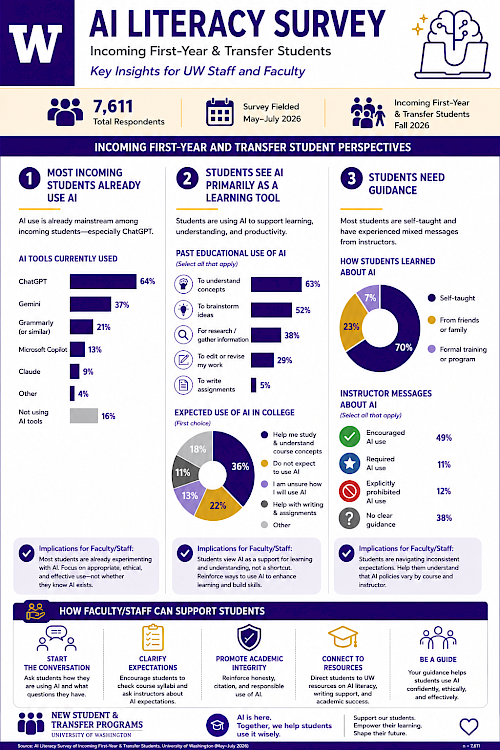
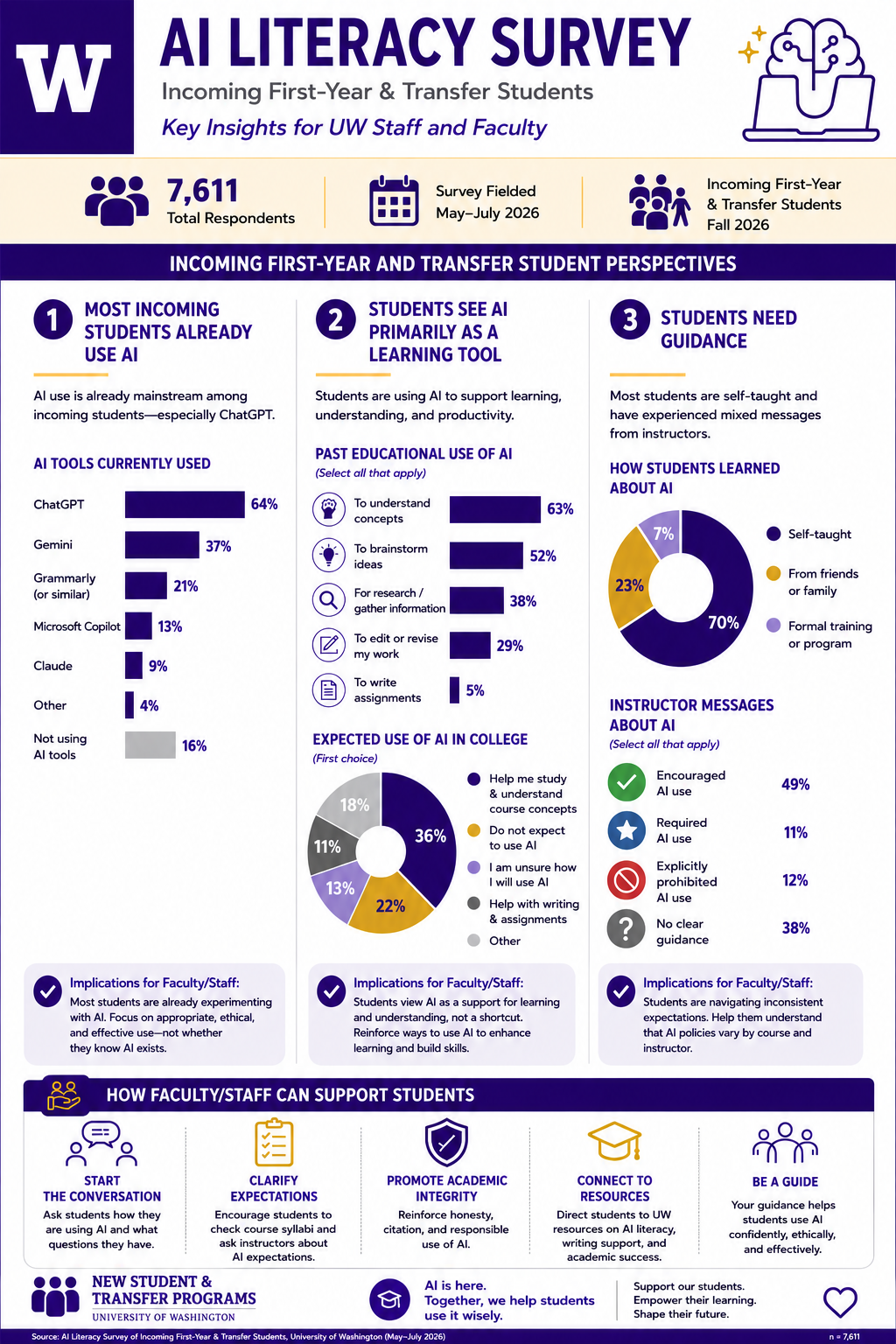
AI Literacy Survey: Incoming First-Year and Transfer Student Perspectives (University of Washington, 2026) This infographic summarizes results from an AI literacy survey of 7,611 incoming first-year and transfer students conducted between May and July 2026 for students entering in Fall 2026. The infographic presents three major findings: 1. Most incoming students already use AI. AI use is common among incoming students, particularly ChatGPT. Reported use of AI tools includes: ChatGPT: 64% Gemini: 37% Grammarly or similar tools: 21% Microsoft Copilot: 13% Claude: 9% Other AI tools: 4% Not using AI tools: 16% Implication for faculty and staff: Most students are already experimenting with AI. Conversations should focus on appropriate, ethical, and effective use rather than basic awareness of AI. 2. Students primarily see AI as a learning tool. Students reported using AI in previous educational settings for: Understanding concepts: 63% Brainstorming ideas: 52% Research and information gathering: 38% Editing or revising work: 29% Writing assignments: 5% When asked how they expect to use AI in college, students selected: Help studying and understanding course concepts: 36% Do not expect to use AI: 22% Unsure how they will use AI: 13% Help with writing assignments: 11% Other uses: 18% Implication for faculty and staff: Students generally view AI as a support tool for learning and understanding rather than as a replacement for their own work. 3. Students need guidance. Most students learned about AI through self-directed exploration. Sources of AI learning include: Self-taught: 70% Friends or family: 23% Formal training or programs: 7% Students also reported receiving mixed messages from instructors about AI: Encouraged AI use: 49% Required AI use: 11% Explicitly prohibited AI use: 12% No clear guidance: 38% Implication for faculty and staff: Students are navigating inconsistent expectations and need clear communication about AI policies and appropriate use within courses. Recommendations for faculty and staff The infographic encourages faculty and staff to: Start conversations about AI use with students. Clarify course and assignment expectations. Promote academic integrity and responsible AI use. Connect students to AI literacy resources. Serve as guides in helping students use AI confidently, ethically, and effectively. The infographic is branded for New Student & Transfer Programs at the University of Washington and highlights the importance of supporting students as they develop AI literacy skills during their transition to college.Alt Text / Long Description AI Literacy Survey: Incoming First-Year and Transfer Student Perspectives (University of Washington, 2026) This infographic summarizes results from an AI literacy survey of 7,611 incoming first-year and transfer students conducted between May and July 2026 for students entering in Fall 2026. The infographic presents three major findings: 1. Most incoming students already use AI. AI use is common among incoming students, particularly ChatGPT. Reported use of AI tools includes: ChatGPT: 64% Gemini: 37% Grammarly or similar tools: 21% Microsoft Copilot: 13% Claude: 9% Other AI tools: 4% Not using AI tools: 16% Implication for faculty and staff: Most students are already experimenting with AI. Conversations should focus on appropriate, ethical, and effective use rather than basic awareness of AI. 2. Students primarily see AI as a learning tool. Students reported using AI in previous educational settings for: Understanding concepts: 63% Brainstorming ideas: 52% Research and information gathering: 38% Editing or revising work: 29% Writing assignments: 5% When asked how they expect to use AI in college, students selected: Help studying and understanding course concepts: 36% Do not expect to use AI: 22% Unsure how they will use AI: 13% Help with writing assignments: 11% Other uses: 18% Implication for faculty and staff: Students generally view AI as a support tool for learning and understanding rather than as a replacement for their own work. 3. Students need guidance. Most students learned about AI through self-directed exploration. Sources of AI learning include: Self-taught: 70% Friends or family: 23% Formal training or programs: 7% Students also reported receiving mixed messages from instructors about AI: Encouraged AI use: 49% Required AI use: 11% Explicitly prohibited AI use: 12% No clear guidance: 38% Implication for faculty and staff: Students are navigating inconsistent expectations and need clear communication about AI policies and appropriate use within courses. Recommendations for faculty and staff The infographic encourages faculty and staff to: Start conversations about AI use with students. Clarify course and assignment expectations. Promote academic integrity and responsible AI use. Connect students to AI literacy resources. Serve as guides in helping students use AI confidently, ethically, and effectively. The infographic is branded for New Student & Transfer Programs at the University of Washington and highlights the importance of supporting students as they develop AI literacy skills during their transition to college.
AI Literacy Survey: Incoming First-Year and Transfer Student Perspectives
Review the summary results from an AI literacy survey of 7,611 incoming first-year and transfer students conducted between May and July 2026 for students entering in Fall 2026.
1. Most incoming students already use AI.
AI use is common among incoming students, particularly ChatGPT. Reported use of AI tools includes:
ChatGPT: 64%
Gemini: 37%
Grammarly or similar tools: 21%
Microsoft Copilot: 13%
Claude: 9%
Other AI tools: 4%
Not using AI tools: 16%
Assume most students are already experimenting with AI before arriving at UW. Conversations should focus on appropriate and responsible use, not whether students know AI exists.
2. Students primarily see AI as a learning tool.
Students reported using AI in previous educational settings for:
Understanding concepts: 63%
Brainstorming ideas: 52%
Research and information gathering: 38%
Editing or revising work: 29%
Writing assignments: 5%
When asked how they expect to use AI in college, students selected:
Help studying and understanding course concepts: 36%
Do not expect to use AI: 22%
Unsure how they will use AI: 13%
Help with writing assignments: 11%
Other uses: 18%
New students generally view AI as a support tool for learning and understanding rather than as a replacement for their own work. The dominant student mindset is AI as a learning support tool rather than a shortcut for completing assignments. Messaging about responsible learning may resonate more than messaging focused solely on academic misconduct.
3. Students need guidance.
Most students learned about AI through self-directed exploration.
Sources of AI learning include:
Self-taught: 70%
Friends or family: 23%
Formal training or programs: 7%
Students also reported receiving mixed messages from instructors about AI:
Encouraged AI use: 49%
Required AI use: 11%
Explicitly prohibited AI use: 12%
No clear guidance: 38%
Incoming students are arriving with very mixed experiences. Students must navigate inconsistent expectations and need clear communication about AI policies and appropriate use within courses. Advisers should consistently remind students that AI expectations vary by instructor and course.
Recommendations for faculty and staff
Start conversations about AI use with students.
Clarify course and assignment expectations.
Promote academic integrity and responsible AI use.
Connect students to AI literacy resources.
Serve as guides in helping students use AI confidently, ethically, and effectively.
Student Acknowledgment
At the end of the survey students signed the following acknowledgment and were provided with the following resources.
I understand it is important to know and understand the expectations of the University and my instructors regarding academic standards. This is especially relevant to the use of technology and online resources available today.
New Student & Transfer Programs fosters a successful undergraduate student experience through strategic programming that focuses on positive academic transitions and the development of learning communities. Through partnerships with faculty, staff, alumni, and student leaders our programs create the space for students to define how they will engage, learn, and thrive at the University of Washington.
Student leadership opportunities
Support new Huskies, gain leadership experience, and make your mark at the UW! Our student employee positions are open to all undergraduate students at the University of Washington in Seattle. Follow the link below to explore our current open positions and learn more about how you can become part of the New Student & Transfer Programs team!